Well, It's been forever since I updated the blog. I should have at least posted the "sorry for not posting" post some time ago. Anyway, it's irrelevant now (and who the heck other than me reads this, anyway?). So here's what I forgot to blog about:
- The
augmented violin project. In 250A (Musical Interaction Design) each student had to submit a final project proposal. Mine would have been a spherical input device replete with encoders, sliders, LEDs, and an accelerometer. However, the final projects were done in groups, so not everyone's project was realized. The one I worked on was an augmented violin, which is a regular violin with electronic sensors added, plus some software to process the sensor data as "gestural input", plus some more software to sonify this gestural data.
- The
Insaniac. The final project in 256A (Music, Computing, Desgin). This was a cross between a granular synthesizer and a kinematics simulation, all wrapped up in an aesthetically pleasant, animated, toy/instrument program. In other words, a glorified screen saver.

- The
Mini-Instrument. A bunch of electronic sensors and LEDs mounted on a piece of foamboard and connected via perfboard to a breadboard with an arduino-based circuit on it. I played with this thing for hours as an input device to some software designed specifically for it. But I didn't record it!
Now, the thing has been destroyed, the parts returning to the Max Lab aether. There is something extremely satisfying about creating something beautiful, not using it, and then destroying it. Ashes to ashes.
EDIT: It wasn't destroyed after all! Yay!
-
The Music Programming Toolkit. AKA MusKit or MTK. Inspired by the Synthesis Toolkit (STK), I wanted to create a class library that can be used to develop music software. What does that mean, exactly? Well, it can mean many things. One the one hand we have STK, which leverages RtAudio and provides a suite of signal processing modules that can be used in any configuration the programmer might conjure. On the other hand we have Juce, a fully-featured cross-platform application development environment, complete with its own audio I/O, graphics engine, IPC, and even plug-in format wrappers. MusKit will fit somewhere in between these two environments. In other words, STK
⊂ MusKit ⊂ Juce. Muskit will provide all the hardware support and signal processing infrastructure as STK, plus a host of classes for connecting DSP modules in a musically meaningful manner (read: sequencing, timing, external control, etc), but it won't go so far as to dictate how your application should be structured. It will still be lightweight enough to easily integrate into a larger framework such as Juce, QT, Cocoa (via obj-c++), etc.
- The DSP final.

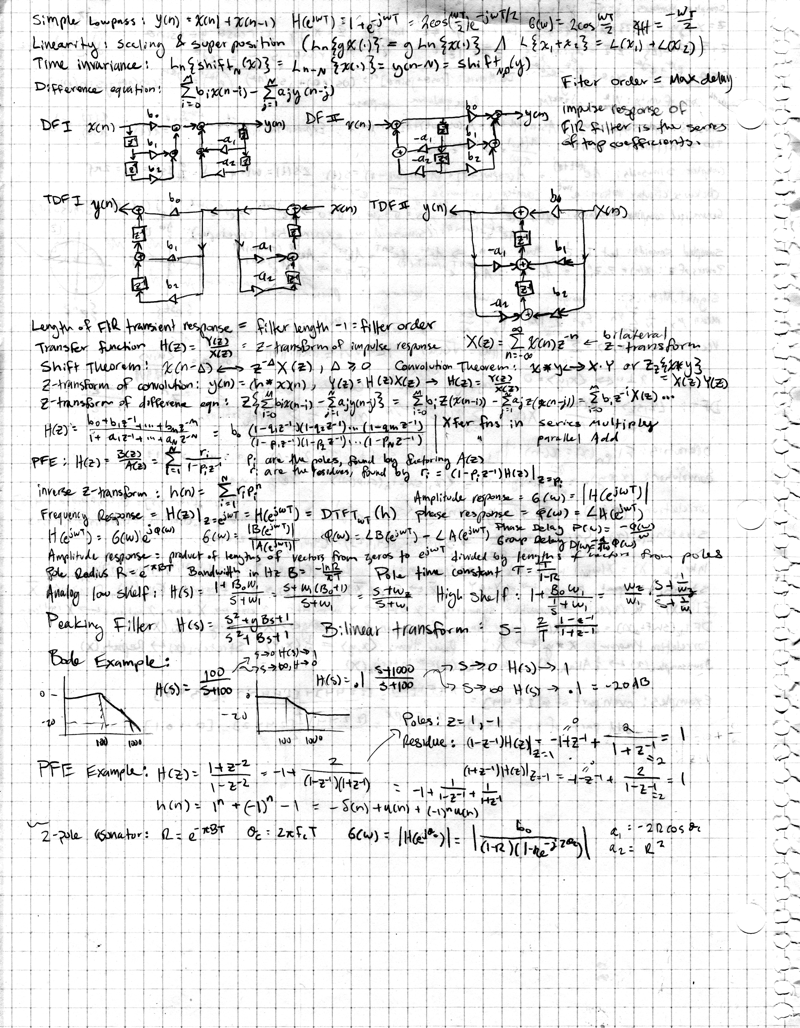
'nuff said.
- Lastly, I've applied to the
CCRMA PhD program. As only two slots are open for it, odds are I won't get it. But not long into the MA program I realized a few things about myself and my goals:
- I have a lot of respect for my professors, and I want to work with them as much as possible.
- I am 5000% more productive than ever before. And I was never a slacker.
- The work I am doing here is the best I've ever done, despite the short duration of each project.
How perfect would it be to have 4-5 more years to follow my pursuits? I would be able to take many classes (in fact, would be required to take at least 135 units), and work on a number of long-term projects.
Don't get me wrong, I want to have a company that makes great software and push the boundaries of what people have come to expect from music technology. But spending all this time at CCRMA, learning so many things, working on so many projects, I'm constantly reminded of one simple fact:
I don't know shit.
 I was warned that Winter quarter would be extremely intense, and it is! I'm enrolled in several extensions or previous courses, namely 256b "Mobile Music" (iPhone programming), 220b "Compositional Algorithms, Spatial Processing, and Psychoacoustics", 192b "Advanced Sound Recording Technology", and 250b "HCI Design and Performance Systems for Music". I'm also taking my first course with the great Julius Orion Smith III AKA "King Nerd" AKA "The Janitor". The course is Music 420 "Signal Processing Models in Musical Acoustics". In other words, Physical Modeling. Julius is sort of the king of audio DSP. He writes, books, lots of books. I've read two of them (1, 2) for the intro to DSP course, and this course is based on this one.